The Room You're Sitting In Is Already Steering Your Day
A few years ago I noticed something embarrassing: I owned a guitar I never played. It lived in a closet behind two coats and a vacuum cleaner. Meanwhile, I could reach my phone without moving my elbow.
I told myself the guitar thing was about discipline. About not wanting it enough. Then one weekend I moved the guitar onto a stand next to the couch, and I played it four times that week — badly, happily, without a single motivational podcast involved.
That's the whole article, honestly. But it's worth unpacking, because most of us are still trying to fix our behavior with willpower when our floor plan is already making the decision for us.
Motivation is the loudest voice in the room. Your space is the one that votes.
Motivation is a feeling, and feelings are terrible project managers. They show up Thursday and vanish Sunday. Your environment, on the other hand, is on the clock 24/7. It's the thing you walk past forty times a day. It's the reason you snack at 3 p.m. without deciding to, or why the yoga mat you unrolled with such good intentions has become a very flat cat bed.
There's a reason behavioral scientists keep coming back to this: habits are triggered by cues, and cues live in physical space. You don't need more resolve. You need better cues in better places.
Friction is a tax you pay every single day
Every action in your home has a small cost attached: the seconds it takes to find something, the decision required to open a drawer, the mild dread of dealing with a pile.
Individually those costs are nothing. Cumulatively, they explain a shocking amount of your life.
Two rules worth taping to the fridge:
- Make the thing you want 20 seconds easier. Shoes by the door. Book on the pillow. Water bottle filled and visible.
- Make the thing you don't want 20 seconds harder. Phone charging in the hallway. Sweets on a high shelf in an opaque container. Streaming app logged out.
Twenty seconds doesn't sound like much. But it's usually the exact width of the gap between "I'll do it" and "eh."
Three cheap changes that actually move the needle
You don't need a renovation, a designer, or a matching set of anything. You need three zones.
1. Build a two-minute reset zone
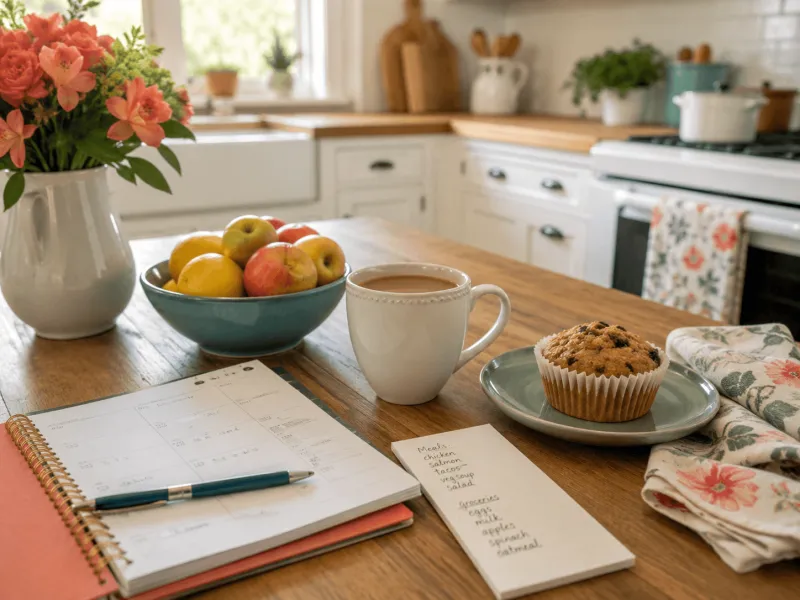
Pick the spot where clutter reproduces — usually the kitchen counter or the entryway table — and give it a home. One tray, one basket, one drawer. Then commit to a two-minute reset every evening: everything that belongs somewhere else goes somewhere else.
The magic isn't tidiness. It's that your home stops being a low-grade to-do list you stare at while trying to relax. Visual clutter is a chore that follows you around the house. Two minutes and it stops following.
2. Put the decision-heavy stuff out of sight
Some items are just decisions wearing a costume. Six boxes of tea. Four half-finished notebooks. A stack of mail. Every time your eye lands on them, your brain runs a tiny, pointless comparison.
Move them into a closed cabinet or an opaque bin. You haven't thrown anything away and you haven't become a minimalist guru. You've just stopped paying a micro-decision fee every time you walk through the room.
3. Design one “yes” corner
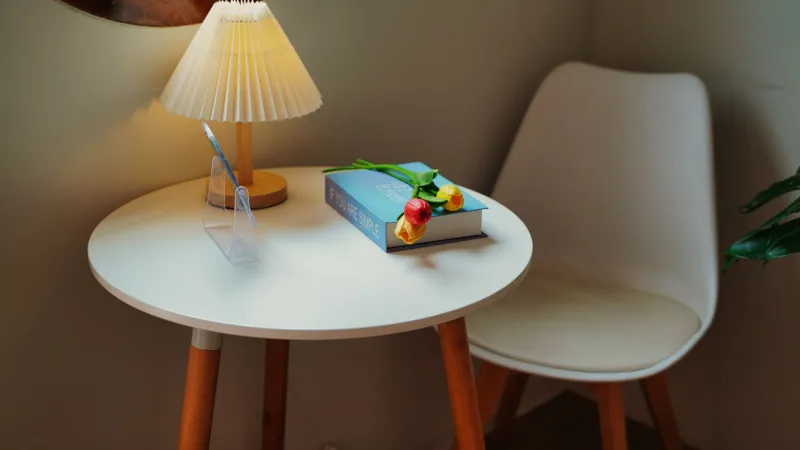
This is the fun one. Choose a single small area — a chair and a lamp, a corner of the counter, a windowsill — and make it the place where the thing you keep meaning to do is already set up.
- Want to read more? Lamp, good light, one book face-out on the arm of the chair.
- Want to stretch? Mat unrolled, or folded and visible, in the corner where you drink your coffee.
- Want to journal? Notebook open, pen resting on the page. Open notebooks are basically invitations.
The rule of the yes corner: it holds exactly one activity and it's always ready. When you sit there, you don't have to decide. That's the entire point.
What to leave alone
Not everything needs optimizing. If a pile of books on the floor makes you happy, keep the pile. If the mismatched mugs bring you joy, keep the mugs.
The goal isn't a showroom. It's a home that leans in your direction. A space so lightly rigged in your favor that on a bad day — a genuinely bad, low-energy, nothing-left-in-the-tank day — the decent choice is still the path of least resistance.
The audit: one room, this week
Don't redesign your whole house on a Tuesday night. Pick one room. Set a fifteen-minute timer and ask three questions:
- What do I keep walking past and ignoring?
- What do I reach for without thinking, and what's making that easy?
- Where's the one spot I could clear right now that would make tomorrow noticeably smoother?
Then change one thing. Move one object. Clear one surface. Notice what happens over the next seven days.
You're not fixing yourself. You're just adjusting the room that's already voting — so that it votes for the life you're actually trying to live.